Ratil
A management platform for Quran memorization associations: students and groups, memorization and attendance, certificates with QR verification, fees, and sponsorships. Each association gets its own address and its data stays isolated, and each user sees only what concerns them.
Visit the Project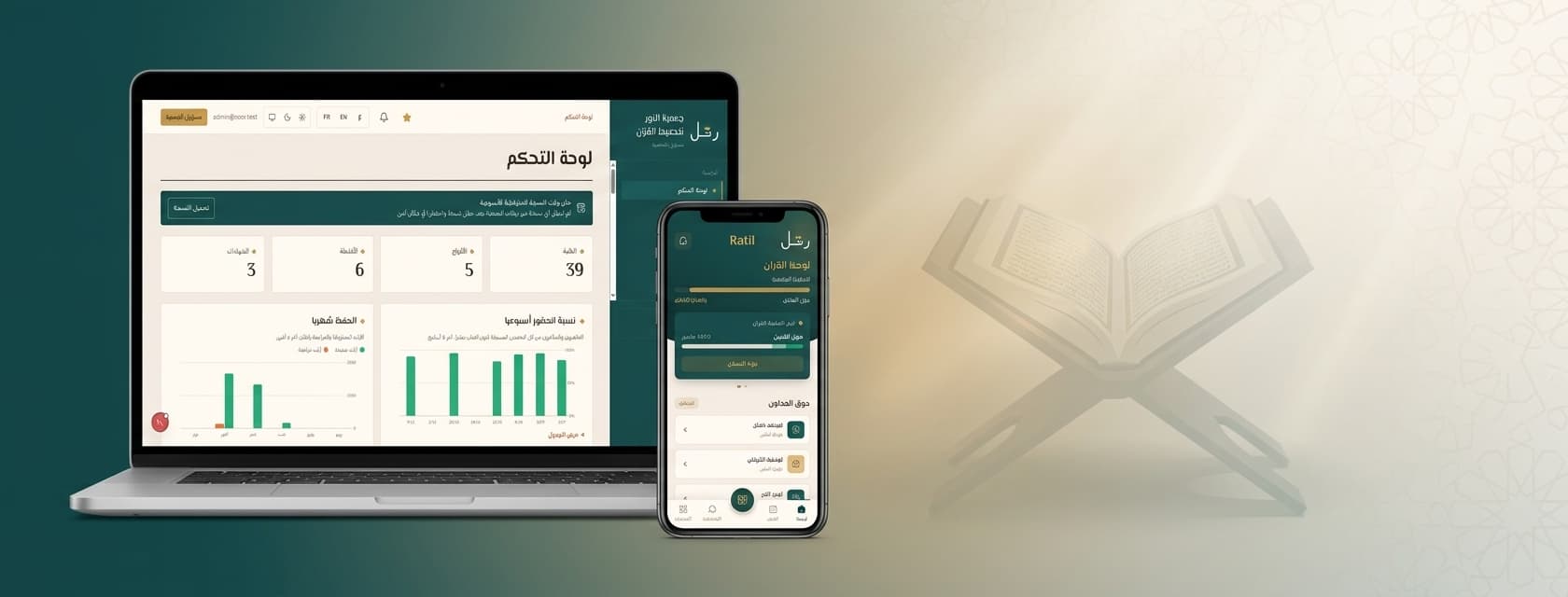
Overview
Ratil (رتّل, "recite") is a management platform for Quran memorization associations. It brings an association's daily work into one place: students and groups, memorization and review, attendance, certificates, fees, and sponsorships for families in need. It is live at ratil.me, in Arabic, French, and English.
The Problem
A Quran memorization association runs a lot of things at once. Teachers track which surahs and verses each student has recited. Staff take attendance at every session, collect monthly fees, and issue certificates when a student finishes a juz'. Many associations also sponsor families in need and manage donations, including zakat.
Most of this usually lives in notebooks, spreadsheets, and messaging groups. Parents don't always know whether their child came to class, a certificate can't easily be checked, and financial records are hard to keep clean.
What Ratil Does
- Memorization and review: every recitation is logged by surah and verse, or by mutun and hadith collections, so each student's progress is visible, with the teacher's notes.
- Attendance: a sheet for every session, with everyone present by default. Parents are notified when their child is absent or late.
- Groups and scheduling: groups for each school year, and a weekly timetable that prevents overlapping sessions.
- Certificates: Ratil suggests a certificate when a student completes a juz' or a text. Certificates are printed with a QR code, and anyone can verify one on the public site.
- Fees and receipts: fees for one student or a whole group, partial payments, and numbered receipts ready to print.
- Sponsorships and aid: sponsors and beneficiaries, paid and overdue months, distribution campaigns with signature sheets, and fund balances, including zakat.
- Remote lessons: scheduled video sessions on Jitsi, with a link that opens fifteen minutes before the start.
- Notifications: email, Telegram, and desktop notifications. Each person picks their own channels.
- Grades and activities: grading scales in numbers or ratings, and activities that need parent approval, attendance, and fees.
- Hijri dates next to Gregorian ones on attendance, certificates, and receipts, with a per-association day offset.
- Excel import: an association can bring in its existing student list, with a preview of each row and its errors before anything is saved.
Seven Roles, Each With Its Own View
Ratil has seven roles: association admin, teacher, parent, student, sponsor, sponsorship and aid manager, and platform admin. Children don't need an account; their parents follow them from a "My children" page. Only adult students get a personal account.
Children's Data Is a Trust
Most users are children, so privacy guided the design:
- Full isolation between associations. No association can see another's data. The isolation is enforced in the database itself, not just in the interface, and it is tested continuously.
- Everyone sees only what concerns them. Permissions are checked on the server for every page and every action.
- Photos only with parental consent. A student's photo is uploaded only with a parent's consent, deleted for good if consent is withdrawn, and stripped of location data.
- Archive, don't delete. Students and financial records are archived rather than deleted, and payments are cancelled with a written reason instead of being erased.
- Private certificate checks. The public verification page shows the student's name only in shortened form.
Today
Ratil is in production at ratil.me. Each association gets its own address on the platform, and associations already using it appear on a public map.